Blog
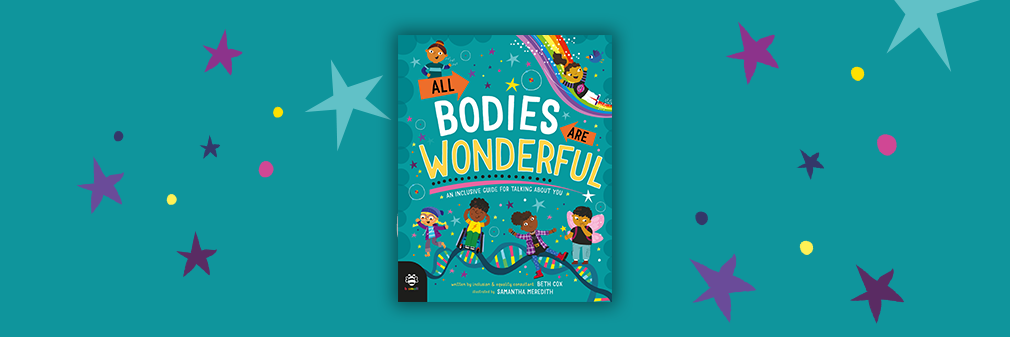
– What is the book about?
All Bodies are Wonderful is about how bodies develop, how they vary, and how this influences the people we become, as well as how the outside world has an impact on who we are. It encourages children to explore who they are, to become aware of the things that influence them, and the discrimination that some people face and why. Finally, it encourages them to challenge biases not they can recognise them.
– How did you approach this topic? Why did you choose this approach?
What amazes me about human bodies is that we aren’t all MORE different.
When I was pregnant with my own child, I read The Incredible Unlikeliness of Being by Alice Roberts. Reading about the intricate process that was going on inside me to create a human being from a tiny cell blew my mind. It was incredible that all the information that was needed to carry out such a complex process was contained in something so small, and that more variation didn’t occur in the process.
So when B Small approached me to write a book celebrating bodies, I knew that I wanted to not just help children see that all bodies are different (and wonderful), but to help them understand WHY all bodies are different. Why differences can occur, and the incredible processes that make us who we are. I wanted to start with the science. If we show that variation in humans is totally natural, we help children to remain open minded about difference.
Much as I find science fascinating, I’m not a scientist, so I knew I needed to work with someone who understood this area in depth to ensure that I wasn’t sharing misinformation – when you are taking incredibly complex subjects and distilling them into easy-to-understand information, this is absolutely key.
I’ve recently realised that I’m autistic, and my desire to approach the book this way makes more sense than ever. The ‘why’ is so important to me.
– You are an Inclusion and Equality consultant. How did you use your expertise to inform your approach as an author?
Inclusion is at the heart of what I do, and an acceptance of all bodies is key to inclusion. Accepting yourself and who you are is vital for positive mental health, so that for me was a fundamental message, but also, if you judge yourself, you judge others. If you can stop judging yourself, you can stop judging others so easily.
For me, it’s so important to focus on similarities first, to help us identify and relate to each other. To do this, it’s vital for characters in the books to be fully rounded. Whilst we only see a few details about the characters in the books, and only find out the names of some of them, they all have names and back stories that I used to influence where they appeared, the comments they made, how they behaved, and so on. They are all very real to me.
Even though I’m an inclusion and equality consultant, I don’t know everything about diversity and I don’t have lived experience of everything featured in the book. This meant it was vital to get insight from various people on the representation to ensure that it was authentic.
– How did you work with the illustrator, Samantha Meredith, on the book?
I think something that will surprise people about book creation is that very often the author and illustrator don’t meet! Samantha and I communicated through Vicky, the Art Director at B Small. I made sure Samantha had each character’s back story so that they could be as real to her as they were for me. We also talked about the nuances of facial expression and the positioning of characters, as well as clothing, hair length and style to make sure that we were presenting a positive message. I also shared a resource to help Samantha depict each character’s ethnicity authentically and without caricature – considering nuances such as face shape rather than just eyes, nose and skin tone.
– How can people use the book?
I think books should be used in any way that works for you! All the information in the book works together, and the order of the pages means that knowledge is built on as you go through the book. However, it’s a lot of information to take on board in one go, so I’d suggest reading it all through initially, but then revisiting certain pages or topics in smaller segments, once you understand the whole concept of the book.

Beth Cox is a children’s book editor and the co-founder of Inclusive Minds and Everybody In. Now living in Wiltshire, Beth works as a freelance consultant providing training to promote inclusion and diversity in publishing.